
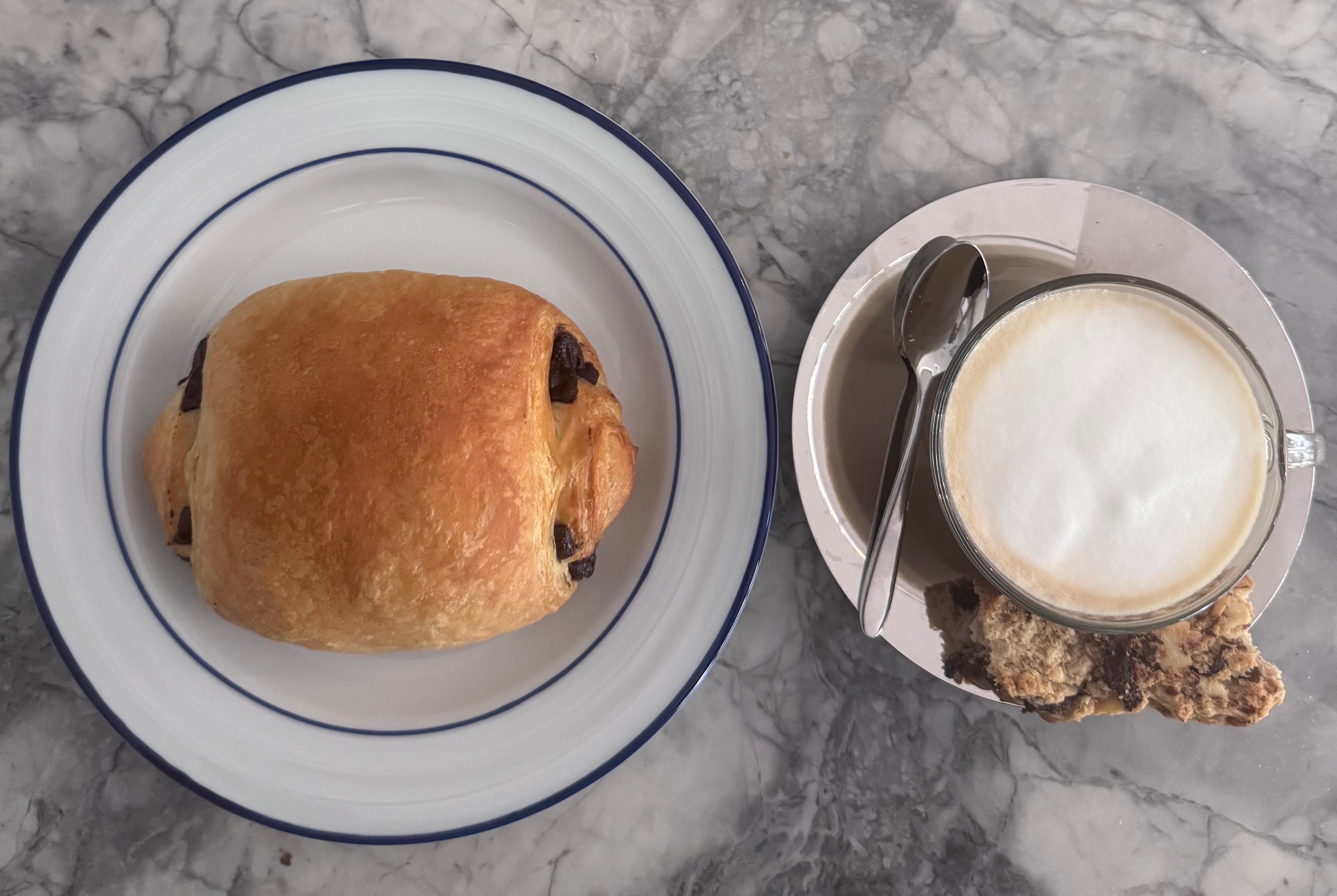
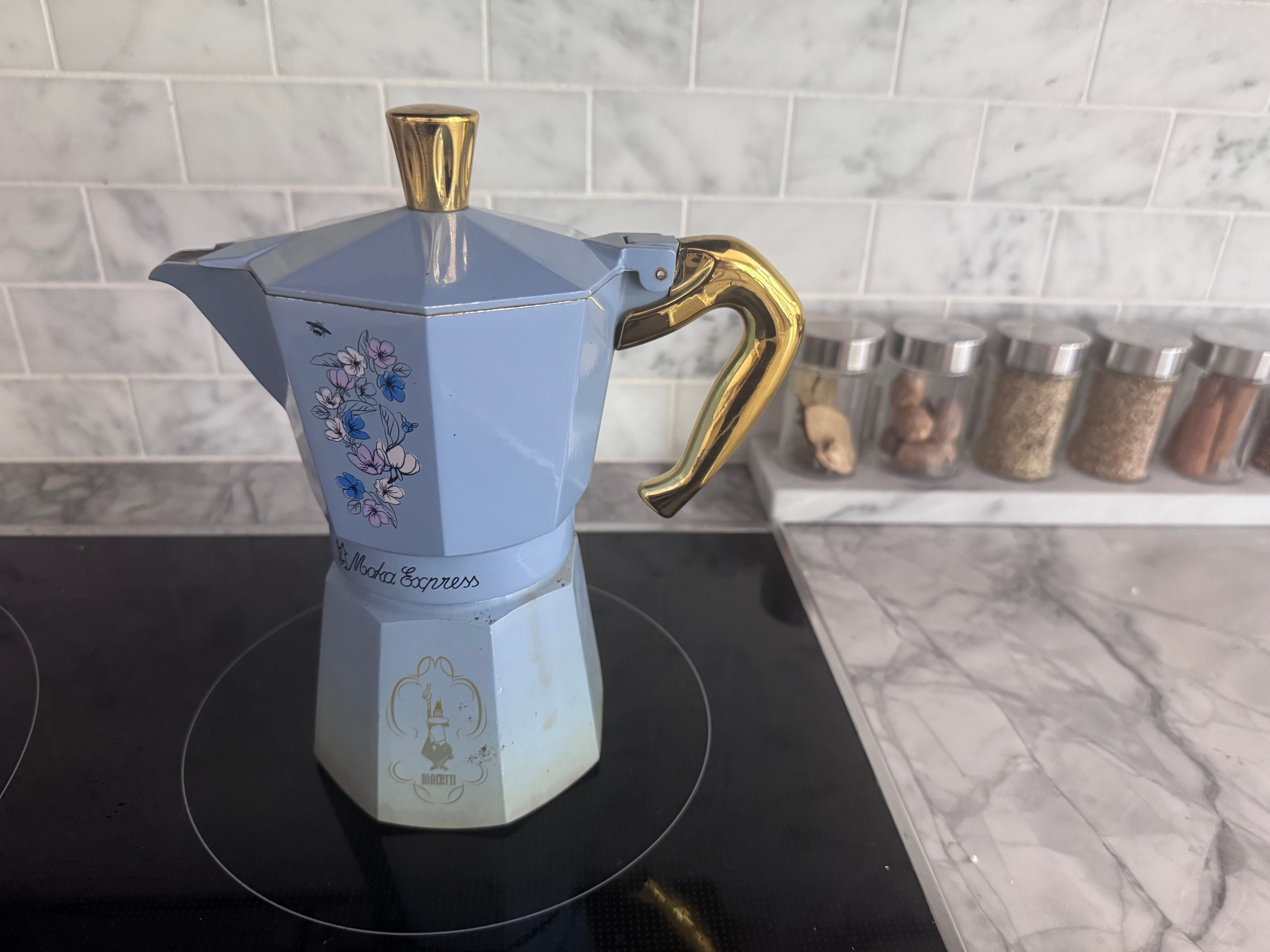
I am sitting here writing with a truly Italian breakfast. A cappuccino made with whole milk and Lavazza espresso brewed with a Bialetti moka pot and a homemade biscotti courtesy of my sister. Oh, and of course a chocolate pastry, un cornetto, though I would call it a croissant if I were in France. I do this every weekend morning. For the length of one cup, it puts me back where I feel I belong the most.
I remember my first visit to Italy, as a 23 year old medical student who knew nothing about the country or how to travel there essentially on her own. My travel companion was my husband, who at the time I had been dating for only two years. He spent his entire life going there every summer to visit family. He was walking back into a place that raised him. I was walking into an adventure I did not yet have words for. I did not know then how much it would become my identity, or how much I would miss it, constantly, when stateside.
This was my husband’s second home. I was a beginner in his belonging. He showed me every place he loved visiting, told me stories about his prior visits there, and about all the friends he made. I was taking it in through a different lens. As we walked around, he knew exactly where he was and where we were going. I had no geographical anchor or sense of time. Everything I saw was completely new. Each moment I lived was writing the foundation of my own connection with a place he was already deeply intertwined with. I have come to think this is how most reinvention actually works. We rarely build a new self out of nothing. More often we are let into something, and then have to decide whether to make it our own.
We have since visited every one to two years, taking our kids starting when they were just infants. This is their second home as well, and I love sharing that feeling with them. Every time we visit, we absolutely must visit my husband’s aunt. She is in her 80s and lives completely independently in the home she has spent her entire life in. It is an unmistakably Italian cultural story, not just her lifetime connection with this home but the way she has maintained it so pristinely in its original form. Such care is taken with everything such that the little scratches and dings give everything character. What must be fixed is fixed, but that which only adds to its beauty is left to tell the story of those who have been part of its life.
There is a paper box I always notice, light blue with the image of a girl on it. It is worn pale and frayed where decades of hands and silverware have crossed the same few inches, and she has never once thought to replace it. The first time I really looked at that box, something in me went quiet. I was standing in a stranger’s kitchen, in a country I had married into, and I recognized myself in it before I could explain why.
I have spent years thinking about that distinction. It is a whole philosophy of a self, kept in a single house. You do not become someone new by sanding off every mark the years have left on you. You decide what to repair and what to keep as evidence that you were here. It is the most honest version of my own work that I know of, and I did not get it from a book. I got it from an 80 year old woman whose home is a major part of her identity.
Her house is not an exception. It is the whole country at a smaller scale. I love to walk around, visit different cafes, try their cappuccino and pastries, get up early to watch the vendors set up, the store owners sweep and spray down their sidewalks, the women walking their dogs in the park (the unhurried wrapping of a sweater I bought for my son still makes me think of Mr. Bean behind the gift counter in Love Actually). And in the afternoon the children playing on the playground while the mothers catch up on life, a daily ritual that is missing here. A sense that there is no rush. The same value the aunt keeps in her furniture, a whole culture keeps in its mornings. Nobody is optimizing. Nobody is sanding anything down to be more efficient. There is time, and the time is the point.
This is the part I want to be honest about. Italy does not give me a different self. It gives a self I already have somewhere to come out. The version of me that moves slowly enough to notice what she actually loves, that is not optimizing the morning, that is allowed to be a beginner again, she is there the whole time. She just has more room there than she does here. Ikigai is usually drawn as the place where what you love, what you are good at, what the world needs, and what sustains you overlap. What no one tells you is how hard that center is to see when you never leave the context that shaped your answers. Travel does not hand me the center. It moves me far enough from the noise to finally see it.
For a long time I lived missing it. I recreated the cappuccino on Saturdays and let the rest of the week be the week. Then I started paying attention to people who did not stop at recreating it. My friend Rebecca Plotnick of Everyday Parisian is one of them. She did not just love Paris. She rebuilt her actual life around not having to leave it to feel like herself. I have kept a door open to a place that returns me to myself for more than twenty years, and mostly I have been content to stand in the doorway. She walked through. She decided at a time her career was forced to pivot to not take the easy route. She took a path that most would not have and stopped visiting the life she wanted. She started living in it. The rest, the writing, the readers, the work that came to her from across Europe, followed from that one decision. It did not cause it.
Most of us cannot fly to Lisbon next week (my other love aside from Italy is Portugal), and that is not really the point. The point is the muscle. The willingness to be a beginner, to have no anchor and no sense of time, to let an 80 year old woman’s house teach you something you could not learn at your own desk. That is the same muscle a career change asks for, or a marriage, or a life. The man whose belonging I was once a beginner in is still beside me, more than twenty years on. Somewhere in all those summers it stopped being his place that he was generous enough to share, and became ours. That is its own kind of reinvention, the slow kind, the kind you only notice looking back. The trip is just the most vivid classroom I have found. The permission, it turns out, was never about the place.
It was about letting what I find there count when I get home.
That gap is what I write about here. Not the leaving. The permission.
Subscribing is free!
If the part that stayed with you is the idea that the self you are missing is not gone, only somewhere you have not thought to look, that is the thread I pulled on in It’s Not Lost. It’s Just Where You Aren’t Looking. This essay is what happens when the place I had not thought to look turned out to be someone else’s kitchen. And if the Ikigai question is the one that will not leave you alone, Finding How You Fit Into Your Life sits closest to it.
—Lauren
More from Lauren at laurenfine.com: practical guides on boundaries, time and habits, plus free worksheets.
Follow me also at https://laurenfine.com
The time is the point - well stated! I adapted coffee in my identity and created a networking series called #42coffees where I share what I learn from people I met for coffee. After 99 episodes I know it needs time to unpack stories ☕️